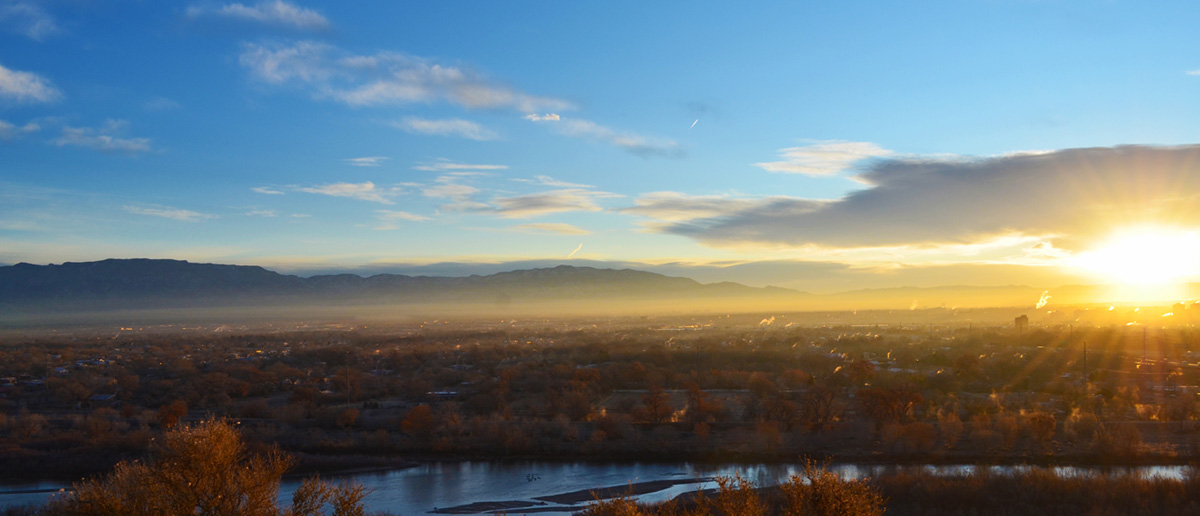
Un Río tan Grande / A River so Big
“I had been afraid of the awful presence of the river, which was the soul of the river, but through her I learned that my spirit shared in the spirit of all things.” – Rudolfo Anaya, Bless Me, Ultima
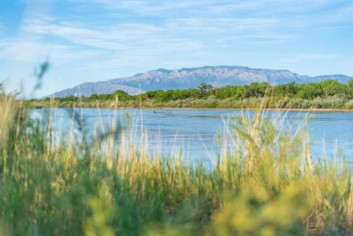
Water in the desert is never taken for granted. It flows down, through, and across the desert’s varied landscapes. Its properties are much like writing itself—they flow, they slip, they change even as we attempt to contain and use them. In the novel quoted above, Bless Me, Ultima, famed New Mexican author and English professor Rudolfo Anaya described how his main character, Antonio, had feared the river. And indeed, the waters brought both good and ill to his family. But its waters always contained lessons to be learned, and a spirit to share with one another. Pushing further, as Barker (2019) articulates via an Indigenous feminism lens, “water teaches us to think about knowledge in continuous movement, transition, change… its analytic values story, humility, care, generosity, and reciprocity.” Much like Antonio, our students might find both fear and joy in their writing. So we should mind the lessons that water, and writing, have to teach us.
One of those lessons is that a river cannot be fully contained, but it can be channeled, and we all benefit from that collective labor. In New Mexico, the acequia system forms the traditional, hybridized Indigenous and hispano backbone for sharing water—the community manages a scarce resource using systems of reciprocal trust and maintenance. People take water from the big flow—the Rio Grande—using an acequia madre or “mother ditch” and divert it for agriculture and drinking, then return it via sangres, canals that flow back to the river. These systems also have to consider the watershed that captures precipitation and spring water, since it all flows down to the river as a single outlet. We as writing centers do that too, as one part of our larger institutions. We participate in communities of sharing resources, restoring practices, and growing with our students, faculty, staff, and community members. As peer tutors, administrators, and writers, we all dip into the same streams and create acequias, but we each do so in unique ways while also relying on one another.
It is in the spirit of sharing, sacredness, and reciprocity, so necessary with both water and writing, that we hope to bring NCPTW together to consider the broad communities of tutoring, writing, and learning that we all participate in. We draw on the literature of creative writing, rhetoric and composition, critical theory, and languages to find theoretical grounding. We link up with educational psychology, communication, and pedagogy to develop our methods. And we share our task with peer tutors, instructors, and staff beyond the scope of the writing center itself. Gunnells and Turner (2024) asked us how in “a time of flux” we might maintain our “commitments to collaboration and care,” and we say that we must build communities for our learners. And community support means that even when the river’s low, it’s big enough for all of us to wade in.
References
Anaya, R. (1972). Bless Me, Ultima. Quinto Sol Publishing.
Barker, J. (2019). Confluence: Water as an Analytic of Indigenous Feminisms. American Indian Culture and Research Journal 43(3), 1-40. https://doi.org/10.17953/aicrj.43.3.barker
Gunnells, A. & Turner, S. (2024). Writing Center Practices in Times of Flux. Praxis: A Writing Center Journal 22(1).